
Six stages. One accountable record.
From the moment an exhibit crosses the counter to the day it is returned, TrueDocX keeps one accountable record — every stage below writes into the same case file, the same custody chain and the same audit ledger.
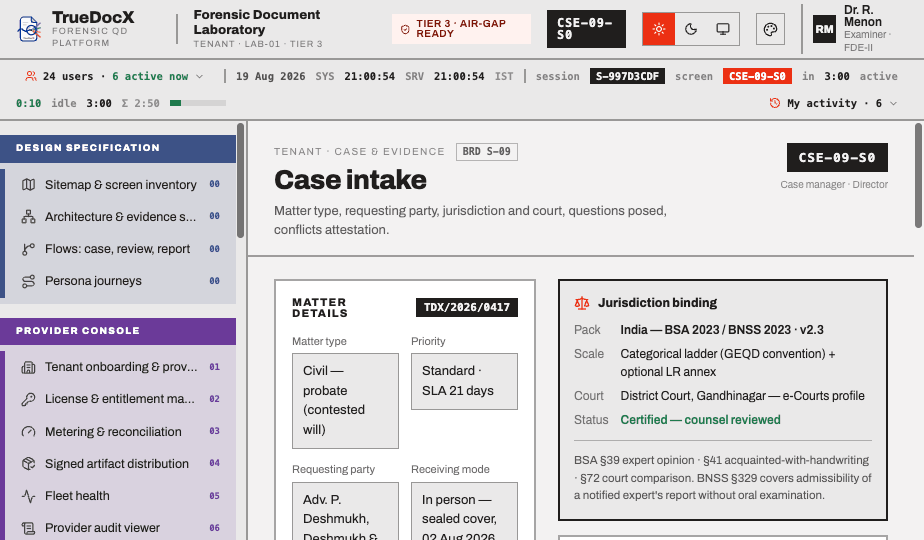
Intake & registration
Cases and exhibits are registered against the requesting agency; custody opens and a receipt hash is sealed on every file.
- Agency registry with matter details, scope of questions and requesting-officer identity
- Exhibit registration per item — Q and K series — with condition notes and packaging photos
- SHA-256 receipt hash sealed on every file; acknowledgment slip generated for the agency
Custody & storage
Exhibits move through explicit custody states — received, in storage, on bench, returned — and every movement is logged.
- Explicit custody states — received, in storage, on bench, in transfer, returned — visible in every evidence view
- Transfers and dispositions use typed confirmation with reason codes; two-person rules where policy requires
- Storage locations, seals and movement history logged to the read-only ledger
Assignment
Directors assign examiners by discipline with workload in view; the case file carries scope, priority and due dates.
- Discipline-based routing — handwriting, signatures, security documents, digital — with examiner workload in view
- Priorities, due dates and court deadlines carried on the case file; queue dashboards per role
- Task claiming for blind work — the second examiner never sees who worked first
Examination
Work happens on dedicated workbenches — imaging, comparison, signature, handwriting, digital — with annotations tied to exhibits.
- Bench tasks open exhibits as sealed derivatives — originals are never touched by analysis
- Findings recorded against exhibits with features, annotations and figure snapshots (each with a microcaption)
- Sequential unmasking keeps contextual case information hidden until the workflow allows it
Peer review
A second examiner reviews blind. Verification and review grades are recorded; conflicts route to structured resolution.
- Blind verification queue with masked exhibits and hidden first-examiner conclusions
- Verification and review grades ([VG]/[RG]) recorded against every method and result
- Disagreements route to structured conflict resolution; release blocks hold the case until closed
Report & release
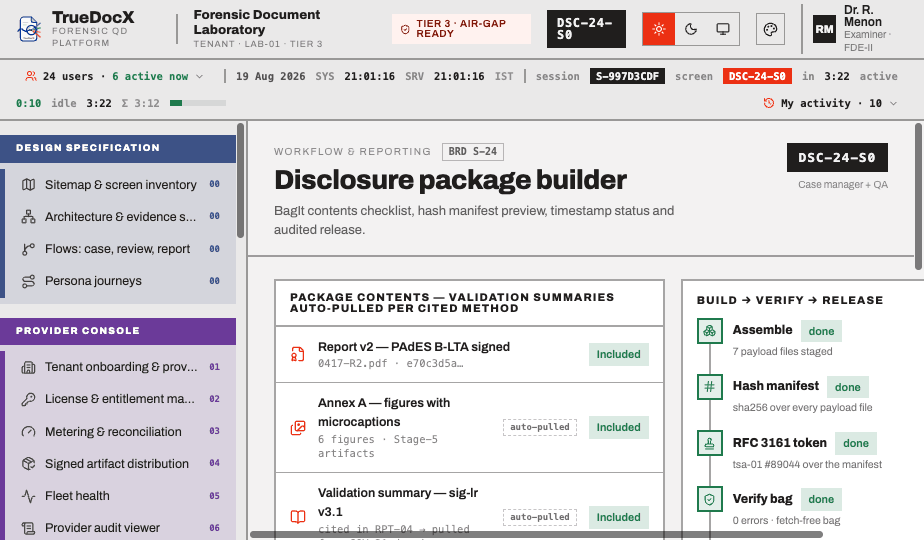
Court-ready reports compile findings with redaction control; release is gated, versioned and accompanied by the full trail.
- Report builder compiles graded conclusions, figures and method disclosures into the laboratory's template
- Redaction re-typesets the page — accepted regions are removed and the pixels underneath never ship — with Bates numbering applied
- Gated, versioned release with hash-stamped output and the full document trail available for discovery
What each stage looks like in the tenant.
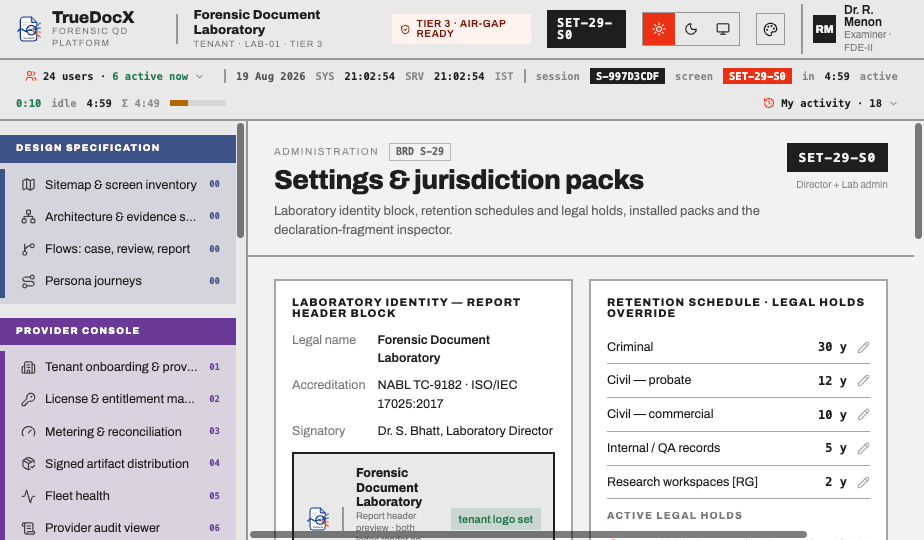
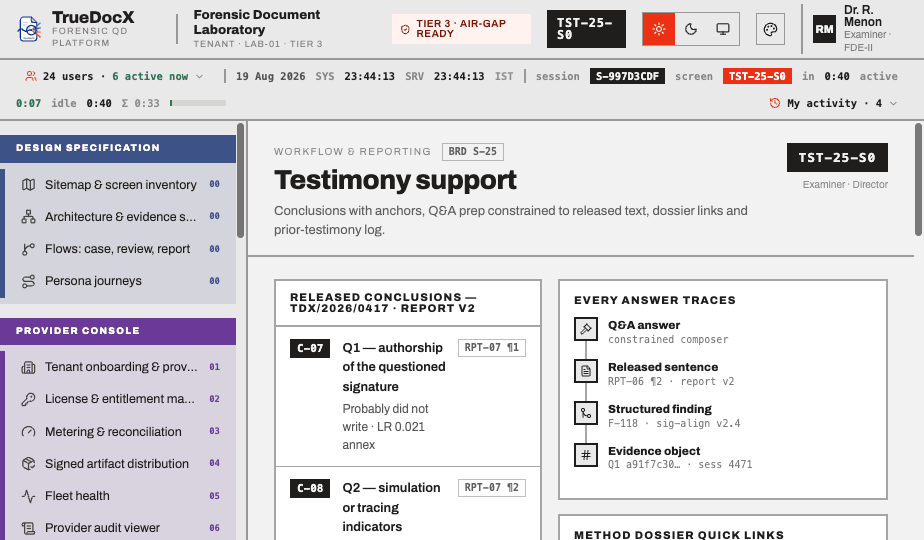
Six governed stages, real screens — every one writing into the same case file, custody chain and audit ledger.
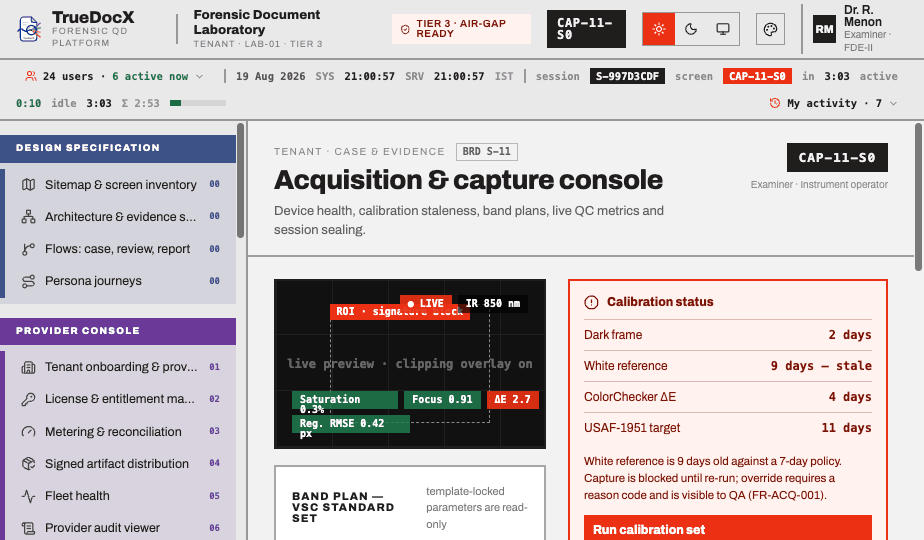
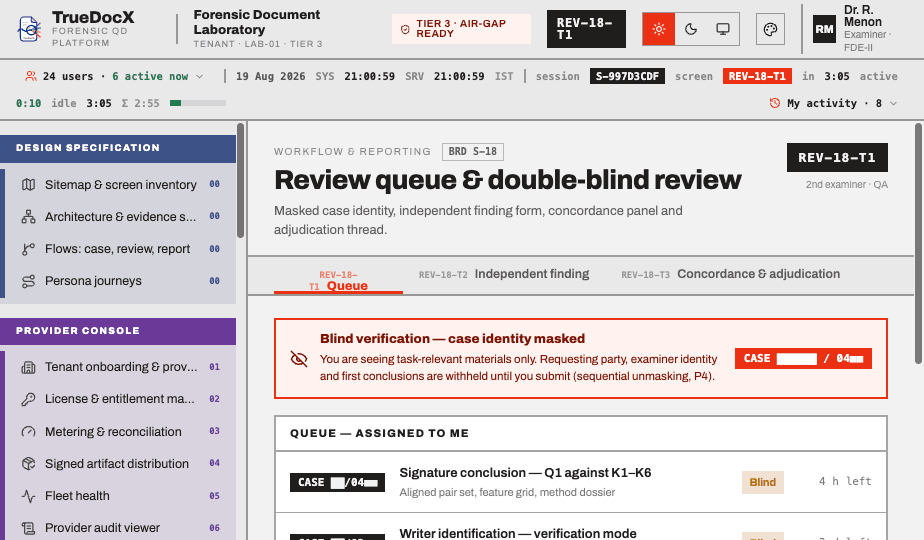
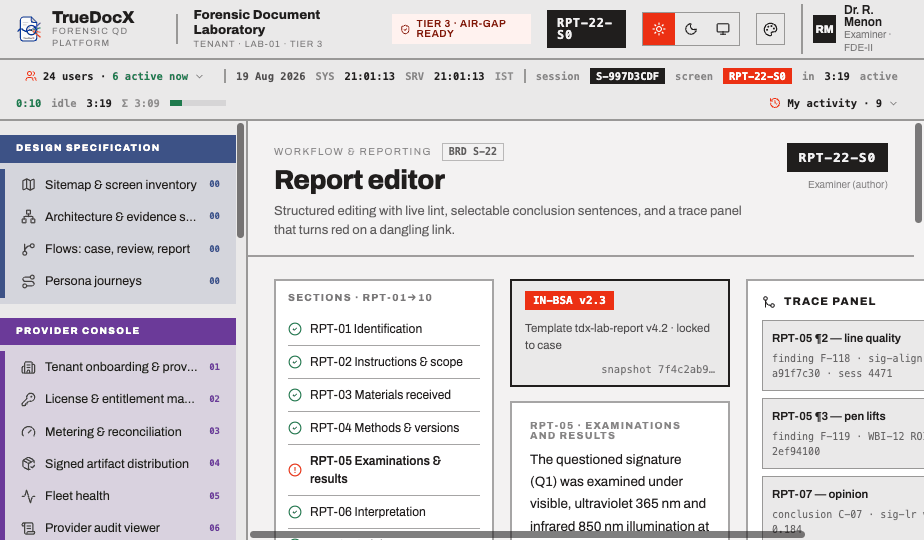
The backbone underneath every stage.
Stable document identity
Every document carries a permanent ID from ingest to disposition — referenced by tasks, findings, reports and the audit ledger alike.
SHA-256 everywhere
Hashed at ingest, re-verified on read, hash prefix shown in the interface chrome — integrity is visible, not assumed.
Version chains
Derivatives, enhancements and annotation layers form parent-linked chains back to the sealed original — nothing exists detached.
Role- and case-scoped ACL
Access follows the assignment: examiners see their cases, reviewers their queue, custodians the vault — nothing more.
Document trail
Per-document history of views, downloads, versions, grades and custody events — exportable for court discovery.
WORM retention
Object-lock compliance mode from bootstrap; retention windows no administrator can shorten or bypass.