A calibrated bench for every discipline.
Five purpose-built examination environments share one evidence store, one annotation model and one audit trail — so tools change, but custody never does.
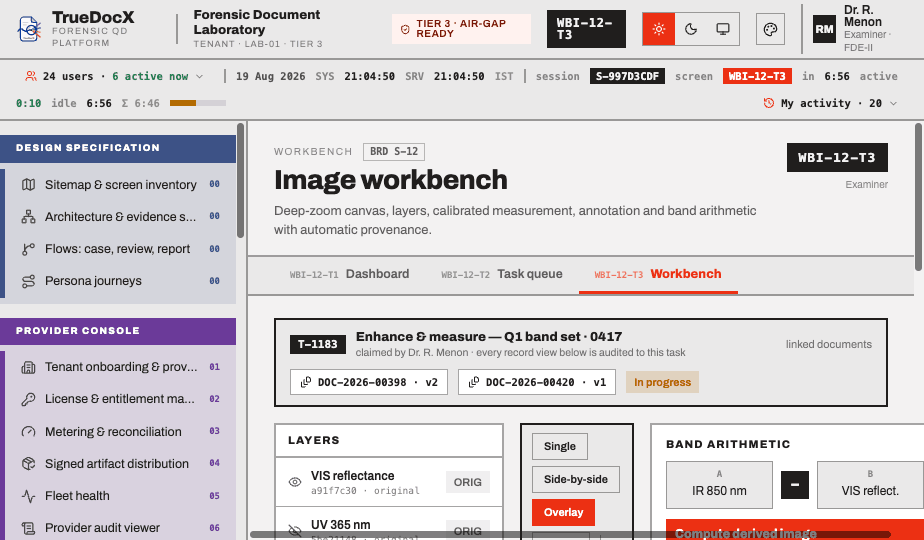
Imaging bench
Multispectral capture and lighting comparison, calibrated magnification, measurement and layered annotation on sealed derivatives.
- Capture sessions linked to exhibits — visible, IR and UV passes recorded with instrument settings
- Deep-zoom tiled imagery with sub-100 ms interaction targets; calibrated measurement and scale bars
- Layered annotations on sealed derivatives; figure snapshots carry microcaptions automatically
Comparison bench
Synchronised side-by-side examination of exhibits with linked pan-zoom, overlays and transparency modes for feature-level comparison.
- Linked pan-zoom keeps both exhibits registered while you move — compare stroke by stroke
- Overlay, blink and transparency modes for feature-level agreement checks
- Comparison notes bound to marked regions on both sides, ready for the report
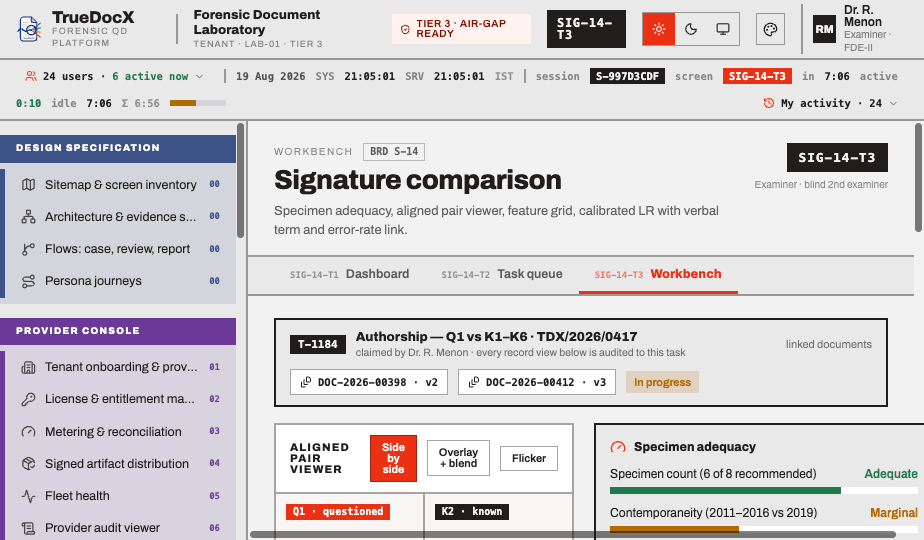
Signature bench
Genuine-versus-questioned signature grids with stroke, fluency and proportion analysis, and exemplar management per subject.
- Genuine-versus-questioned grids with exemplar management per subject and admitted standards
- Stroke order, fluency, pressure and proportion analysis recorded as tagged features
- Statistical support with calibrated likelihood-ratio methods — Cllr and validation set disclosed with every run
Handwriting bench
Characteristic charts, letterform comparison and writer-profile worksheets built from tagged features across exhibits.
- Characteristic charts and letterform comparison built from tagged features across exhibits
- Writer-corpus management — supervised dictation and course-of-business collections, with script coverage flags
- Model-assisted comparison with error rates linked and scope limits declared per script
Digital documents
Metadata, incremental updates, object streams, revision history and signature validation for born-digital and scanned PDFs.
- Metadata, incremental updates and object-stream parsing reveal how a file was assembled
- Revision history reconstruction — see the document before and after each saved change
- Digital-signature validation with post-signature change flags surfaced on the case record
The bench, as the examiner sees it.
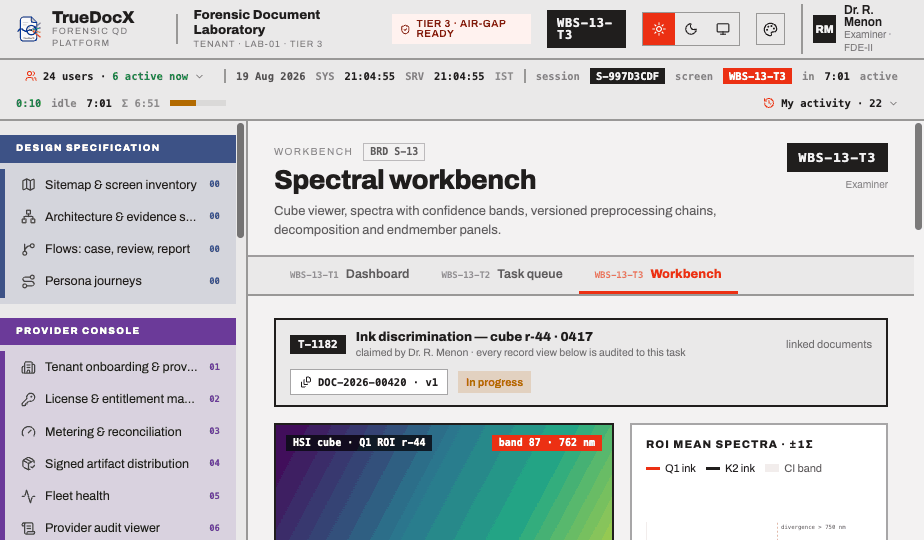
Every workbench works on sealed derivatives, keeps exhibit identity in the chrome, and records method, version and parameters with each result.
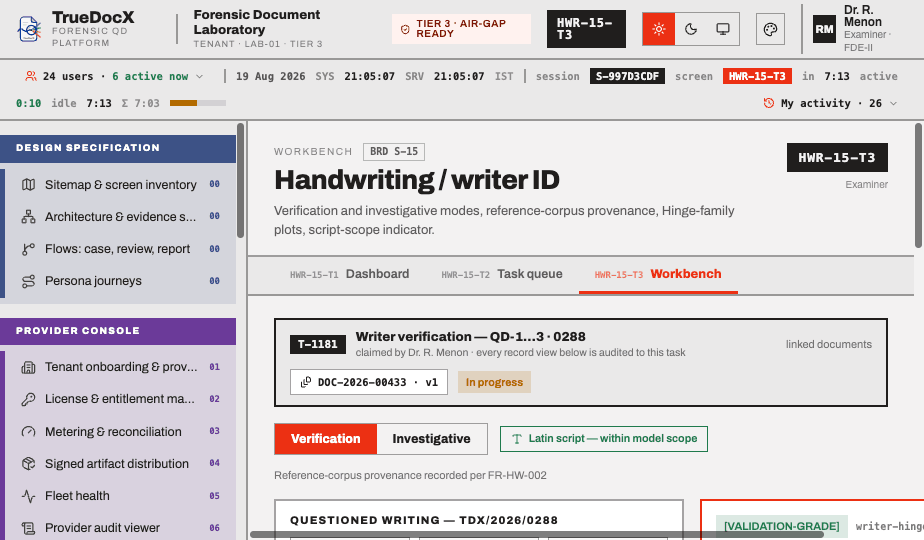
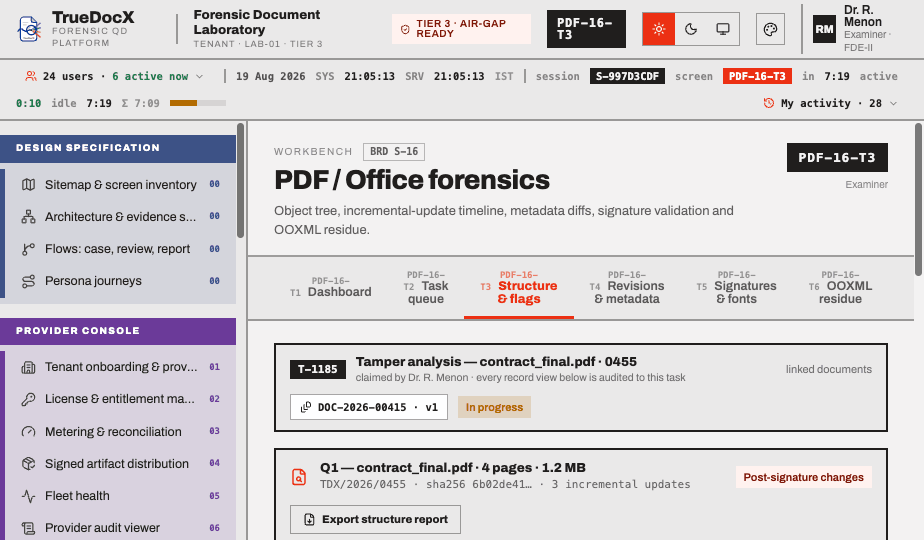
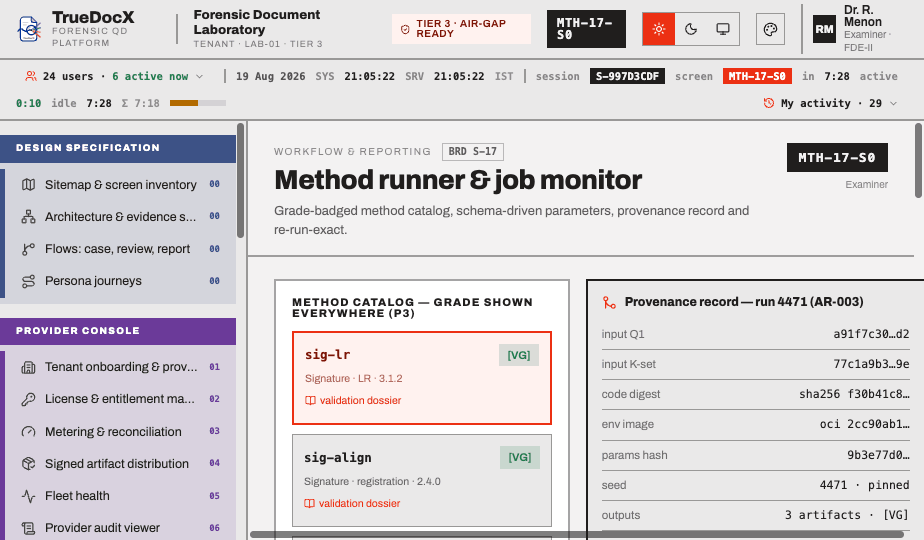
![Model and method governance — [VG]/[RG] grades, drift envelopes and deployment stage.](assets/screens/gov-21-governance.png)
Analytical methods are governed like evidence.
Versioned methods
Every analytical method ships as a versioned release with public release notes — reports cite the exact version used.
[VG] / [RG] grading
Validation and reliability grades travel with methods and their results across every screen and into the report.
Local execution
Methods run inside the tenant — local-compute-only policy means evidence never leaves the laboratory to be analysed.
Hash-stamped runs
Each run produces a manifest — inputs, parameters, outputs, hashes — sealed to the case record for reproduction.